
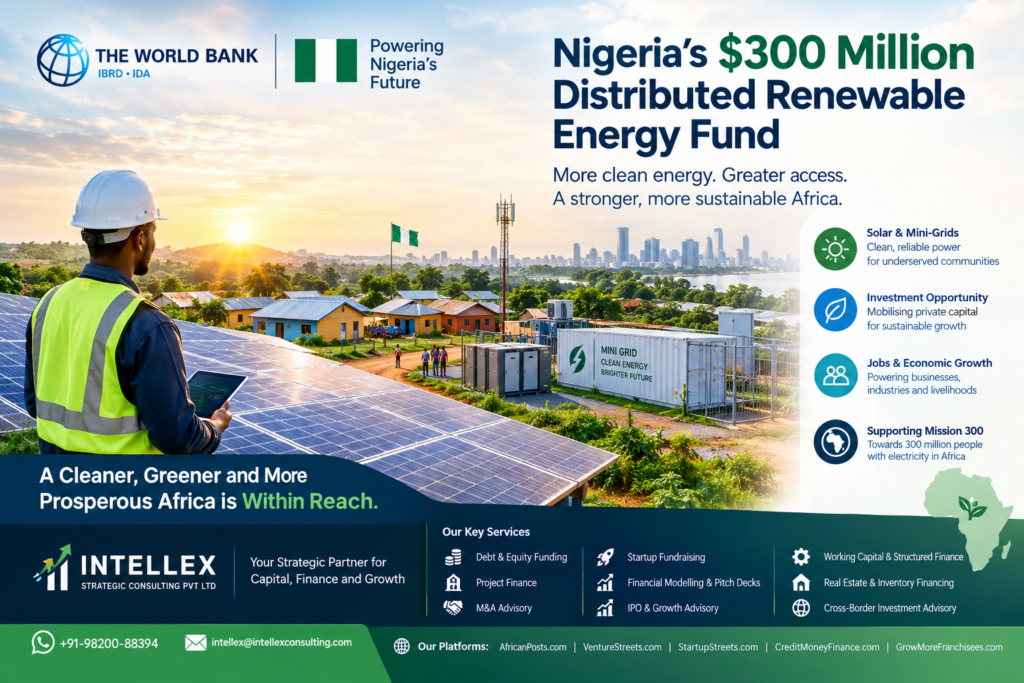
Nigeria’s $300M Off-Grid Power Fund: Investment Opportunities for African Startups, Developers and Global Investors.
Nigeria’s $300 Million Distributed Renewable Energy Fund: What the World Bank-Backed Initiative Means for Africa’s Energy, Investment and Startup Ecosystem.
Nigeria’s $300M Distributed Renewable Energy Fund, backed by an initial $25M World Bank commitment, could accelerate mini-grids, solar and off-grid investment. Explore the opportunities for African businesses, investors and project developers, and how Intellex Strategic Consulting can support fundraising, project finance and capital strategy.
Nigeria’s $300 Million Renewable Energy Fund Could Open a New Chapter for Africa’s Energy Investment
Nigeria has taken a significant step toward expanding distributed renewable energy after commercially launching a $300 million Nigeria Distributed Renewable Energy (DRE) Fund, designed to attract and deploy capital into mini-grids, standalone solar systems and other decentralised electricity projects.
The development is particularly important because it sits at the intersection of three major trends: Africa’s electricity-access challenge, the rapid growth of distributed renewable energy, and the increasing need to mobilise private capital into infrastructure.
The fund has the backing of major development and infrastructure institutions, with the World Bank providing an initial $25 million commitment through the International Development Association (IDA). The vehicle is being co-managed by the Nigeria Sovereign Investment Authority (NSIA) and Africa50, with Sustainable Energy for All (SEforALL) also involved.
Importantly, the $25 million World Bank commitment should not be interpreted as the World Bank financing the entire $300 million fund. It is an initial contribution intended to help mobilise additional capital.
For investors, project developers, energy startups and financial advisors, this distinction matters.
The opportunity is not simply about one $300 million fund. It reflects a broader shift toward investment models that combine development finance, institutional capital and private-sector participation to finance commercially viable infrastructure.
A Major Financing Platform for Nigeria’s Off-Grid Energy Market
The Nigeria DRE Fund has been established to support distributed renewable energy projects, particularly where conventional grid infrastructure does not adequately serve communities and businesses.
Potential project categories include:
- Solar mini-grids
- Standalone solar systems
- Commercial and industrial renewable-energy projects
- Distributed power infrastructure
- Energy systems for underserved communities
- Renewable-energy solutions for businesses
- Productive-use energy projects
- Other decentralised electricity solutions
The commercial launch represents a move from fund structuring toward capital deployment, according to Africa50 and SEforALL.
That transition is significant.
A fund can remain a policy announcement for years unless it has a functioning investment structure, capital commitments, investment criteria, project pipeline and mechanisms for deployment.
The Nigeria DRE Fund is intended to address that gap by creating a dedicated financing platform for distributed renewable energy.
Why Distributed Renewable Energy Matters for Africa
Africa’s energy challenge is not simply a question of generating more electricity.
It is also about how electricity reaches people and businesses.
Large centralised power infrastructure requires substantial investment in generation, transmission and distribution networks. In remote or sparsely populated areas, extending traditional grid infrastructure can be difficult and expensive.
Distributed renewable energy provides another pathway.
Instead of generating electricity at a large central power plant and transmitting it over long distances, electricity can be produced closer to where it is consumed.
A solar mini-grid, for example, can provide electricity to a community without waiting for a full national-grid extension.
A commercial solar installation can help a business reduce dependence on unreliable grid electricity and diesel generation.
A standalone solar system can provide electricity where grid connectivity is unavailable.
This makes distributed renewable energy both an energy-access solution and an infrastructure investment opportunity.
The Bigger Picture: Mission 300
The Nigeria DRE Fund is also connected to a much larger continental ambition.
The World Bank Group and African Development Bank Group’s Mission 300 initiative aims to provide electricity access to 300 million people in Africa by 2030.
The World Bank says that, as of 2024, approximately 560 million people in Sub-Saharan Africa still lacked access to electricity. Mission 300 combines grid expansion with distributed renewable energy, policy reforms and private-sector investment.
The initiative is therefore not simply about building power plants.
It is about creating an ecosystem capable of financing and delivering electricity connections at enormous scale.
In June 2026, the World Bank reported that Mission 300 had already connected more than 50 million people across 40 African countries, marking an important milestone while leaving a substantial distance to the 2030 target.
Nigeria’s new fund is one of the mechanisms that can contribute to this broader effort.
What the $25 Million World Bank Commitment Actually Signals
The initial World Bank commitment is important beyond its absolute dollar value.
Development-finance institutions can play a catalytic role in markets where private investors perceive significant risks.
In Nigeria’s power sector, potential investment considerations include:
- Currency volatility
- Project-development risk
- Electricity tariff structures
- Long investment horizons
- Availability of local-currency financing
- Regulatory uncertainty
- Counterparty risk
- Collection and payment risk
- Infrastructure-development risk
- Project execution capacity
A development institution participating in a financing structure can potentially help create conditions under which other investors are more willing to participate.
The structure is therefore important because it can help crowd in additional private and institutional capital rather than replacing it.
Africa50 describes the fund as a platform designed to leverage public finance to mobilise private investment and develop scalable distributed-renewable-energy projects.
The Investment Opportunity Is Bigger Than Nigeria
Nigeria is the immediate focus, but the underlying model has continental implications.
Africa needs significant investment in:
- Renewable power generation
- Mini-grids
- Solar infrastructure
- Battery storage
- Energy-as-a-service models
- Transmission
- Distribution
- Smart metering
- Energy financing platforms
- Climate technology
- Energy-efficiency solutions
- Productive-use applications
This creates opportunities not only for large infrastructure companies but also for startups and emerging businesses.
A company developing affordable solar systems for African SMEs, for example, may eventually become part of a much larger infrastructure-financing ecosystem.
Similarly, a fintech company specialising in energy payments, a company providing remote monitoring for mini-grids, or a climate-tech business developing energy-management software may become an important part of the value chain.
Why African Energy Startups Should Pay Attention
The energy transition is creating a new category of African businesses.
Historically, infrastructure investment was dominated by large utilities, governments and multinational corporations.
The distributed-energy model changes the equation.
Smaller companies can participate in specific parts of the value chain.
Examples include:
1. Solar developers
Companies developing commercial solar and mini-grid projects can build portfolios rather than relying on one large project.
2. Energy-as-a-Service companies
Businesses can provide electricity to customers through service-based commercial models rather than requiring customers to purchase the entire energy system upfront.
3. Battery and storage companies
As renewable generation expands, storage becomes increasingly important for reliability and load management.
4. Energy fintech
Digital payment, metering, credit assessment and collections can improve the commercial viability of distributed-energy systems.
5. Climate-tech startups
Software can help operators monitor energy production, predict maintenance requirements and optimise assets.
6. Productive-use energy businesses
Reliable electricity can support agriculture, refrigeration, manufacturing, healthcare, education and small-business operations.
This creates opportunities where energy infrastructure and entrepreneurship intersect.
The Financing Challenge: Having a Good Project Is Not Enough
One of the most important lessons from large infrastructure programmes is that capital does not automatically flow to every project.
A renewable-energy company may have a strong technology but still struggle to raise capital.
Investors typically need answers to fundamental questions:
How much capital is required?
What will the money be used for?
What is the expected project cash flow?
Who will purchase the electricity?
What are the contractual arrangements?
What are the regulatory assumptions?
What are the currency risks?
What is the repayment or investor-exit mechanism?
What is the project’s financial model?
What happens under downside scenarios?
This is where professional financial structuring becomes critical.
A project can be commercially attractive but remain difficult to finance if the investment proposition has not been translated into an investor-ready structure.
Project Finance Will Become Increasingly Important
The growth of renewable energy across Africa will require more than venture capital.
Different projects require different forms of capital.
A startup developing an energy technology may need equity funding.
A solar developer constructing operating assets may require project finance or debt.
A growing energy company may require working capital.
An established infrastructure business may seek strategic investors or private equity.
A company expanding across multiple African markets may consider M&A or structured finance.
This creates a multi-layered capital requirement.
The future African energy market is therefore likely to involve a combination of:
Equity + Debt + Project Finance + Development Finance + Institutional Capital + Strategic Investment
Where India Can Play a Role
There is also an important India-Africa connection.
India has developed significant capabilities across solar energy, digital payments, financial technology, affordable technology deployment, infrastructure development and entrepreneurship.
Africa50 specifically highlighted the potential for knowledge transfer between Africa and India in connection with the Nigeria DRE Fund and the development of scalable distributed-renewable-energy models.
This creates potential opportunities for Indian companies with:
- Renewable-energy technology
- Solar EPC capabilities
- Energy-financing expertise
- Fintech platforms
- Infrastructure solutions
- Climate-tech products
- Manufacturing capabilities
- Engineering services
- Digital infrastructure
- Investment and financial advisory expertise
The opportunity can work in both directions.
African businesses can seek Indian technology, capital and expertise, while Indian companies can explore African markets and partnerships.
The Role of Financial Advisors in the Emerging Africa-India Investment Corridor
Large-scale capital mobilisation requires more than identifying investors.
Businesses need to become investment-ready.
That means preparing the financial and commercial infrastructure around the opportunity.
For example:
Financial modelling
A robust financial model can help investors understand:
- Revenue assumptions
- Operating costs
- Capital expenditure
- Cash flows
- Debt servicing
- Project returns
- Sensitivity analysis
- Downside scenarios
Investor documentation
Investors need clear information about:
- Business model
- Market opportunity
- Management
- Capital requirement
- Use of funds
- Financial performance
- Growth strategy
- Investment structure
Capital strategy
Companies need to determine whether their requirements are best suited to:
- Equity
- Debt
- Project finance
- Structured finance
- Strategic investment
- Venture capital
- Private equity
- Institutional capital
Transaction advisory
As businesses grow, opportunities can emerge for:
- Joint ventures
- Strategic partnerships
- Acquisitions
- Mergers
- Cross-border expansion
- Infrastructure partnerships
This is where professional advisory support can materially improve the quality of a capital-raising process.
Intellex Strategic Consulting: Supporting Capital, Finance and Growth
Intellex Strategic Consulting Pvt Ltd provides financial and strategic advisory support to businesses seeking capital, expansion and transaction opportunities across India and international markets.
For companies participating in sectors such as renewable energy, infrastructure, climate technology, manufacturing, real estate, technology and startups, the firm’s services can support the process of moving from a business concept or growth plan toward an investor-ready proposition.
Key areas of support include:
Debt Funding
Support in structuring and pursuing appropriate debt-financing opportunities.
Equity Funding
Assistance for businesses seeking strategic investors, private capital or growth equity.
Project Finance
Financial structuring support for infrastructure and capital-intensive projects.
Working Capital & Structured Finance
Solutions designed around business cash flows, assets, contracts and funding requirements.
Real Estate & Inventory Financing
Capital solutions for asset-backed and inventory-driven businesses.
M&A Advisory
Support for mergers, acquisitions, strategic partnerships and business expansion.
Startup Fundraising
Support for startups from seed through growth stages, including investment-readiness and investor outreach.
Financial Modelling & Pitch Deck Support
Development and refinement of financial models, investor presentations and fundraising documentation.
IPO & Growth Advisory
Strategic support for companies preparing for larger capital-market opportunities and growth.
What Renewable-Energy Companies Should Prepare Before Approaching Investors
The emergence of large financing platforms such as Nigeria’s DRE Fund should encourage energy entrepreneurs to strengthen their investment readiness.
A project developer should ideally be able to present a clear investment package covering:
1. Executive Summary
A concise explanation of the business and project.
2. Market Opportunity
Evidence supporting the demand for the proposed energy solution.
3. Project Pipeline
Details of current and prospective projects.
4. Business Model
How the company generates revenue.
5. Financial Model
Detailed projections supported by transparent assumptions.
6. Capital Requirement
Exactly how much capital is required and when.
7. Use of Funds
A clear allocation of the capital being raised.
8. Risk Analysis
Commercial, regulatory, currency, technology and execution risks.
9. Management Team
Experience and capabilities relevant to project delivery.
10. Investor Exit or Repayment Structure
A clearly articulated mechanism through which investors can receive returns.
This preparation can significantly improve the quality of investor discussions.
From Energy Access to Economic Development
The importance of electricity extends far beyond the energy sector.
Reliable electricity can influence:
- Manufacturing
- Agriculture
- Healthcare
- Education
- Telecommunications
- Digital businesses
- Retail
- Cold-chain infrastructure
- Small and medium enterprises
- Financial services
A small manufacturing business cannot reliably increase production if electricity is unavailable.
A healthcare facility needs dependable power for refrigeration and medical equipment.
A farmer needs electricity for irrigation and processing.
A digital business needs power for connectivity and equipment.
Consequently, distributed renewable energy can become an economic-enablement platform, not merely an electricity solution.
The World Bank’s Mission 300 framework explicitly connects electricity access with jobs, businesses, agriculture, education, healthcare and economic growth.
What Investors Should Watch Going Forward
The announcement of the $300 million fund is significant, but investors and entrepreneurs should distinguish between capital mobilisation, capital commitment and capital deployment.
These are different stages.
A fund target does not necessarily mean the entire target has already been raised.
A commitment does not necessarily mean all funds have already been deployed.
And a project pipeline does not necessarily mean projects have reached financial close.
The next indicators to watch will therefore include:
- Additional capital commitments
- First investment transactions
- Project selection
- Fund deployment
- Private-sector participation
- Institutional investor participation
- Local-currency financing
- Number of projects financed
- Electricity connections created
- Commercial performance of financed projects
- Replication of the model in other African countries
These indicators will help demonstrate whether the financing model can move from announcement to scalable implementation.
A New Opportunity for African Entrepreneurs and Global Investors
Nigeria’s $300 million DRE Fund arrives at a time when the African investment landscape is increasingly focused on infrastructure, energy access, climate technology and private-sector development.
For entrepreneurs, the message is clear: energy access is becoming an investable business sector.
For investors, the opportunity extends beyond traditional utilities into distributed infrastructure, technology, financing platforms and service businesses.
For Indian companies, there may be opportunities to contribute technology, expertise, capital and execution capabilities.
And for financial advisors, the opportunity lies in helping businesses bridge the gap between commercial potential and investment readiness.
The Nigeria DRE Fund is therefore more than a financing announcement. It represents an evolving approach to African infrastructure finance—one that seeks to combine public-sector support, development finance, institutional capital and private investment around commercially scalable energy projects.
Looking to Raise Capital, Finance a Project or Expand Internationally?
Businesses across India, Africa and global markets seeking capital or strategic growth support can explore professional advisory assistance from Intellex Strategic Consulting Pvt Ltd.
Whether the requirement involves debt funding, equity investment, project finance, structured finance, startup fundraising, M&A, financial modelling or investor presentation support, the objective is to help businesses develop a clear and professionally structured capital strategy.
For business and investment advisory enquiries:
📱 WhatsApp: +91-98200-88394
📧 Email: intellex@intellexconsulting.com
Explore our platforms:
AfricanPosts.com
VentureStreets.com
StartupStreets.com
CreditMoneyFinance.com
GrowMoreFranchisees.com
Intellex Strategic Consulting Pvt Ltd — Supporting businesses with capital strategy, fundraising, project finance and growth advisory across India and global markets.
More Featured Articles:
Launch Your Own Skincare, Haircare & Personal Care Brand Through White-Label Manufacturing.
Private Equity & Venture Capital: Financing the Next Growth Chapter of Startups and Businesses.
11 Priceless Personal Growth Lessons That Can Transform Your Financial Success and Life.
15 Powerful Money Lessons from The Psychology of Money That Can Transform Your Financial Future.
How Startups Can Raise Funding in Dubai: A Comprehensive Guide for Founders and Entrepreneurs.
The Ultimate Guide to Company Registration in Dubai 2026: Benefits, Compliance, and Costs.
Why Kjøller (Dubai) is an important Venture Capital Investor for Startups Globally.