
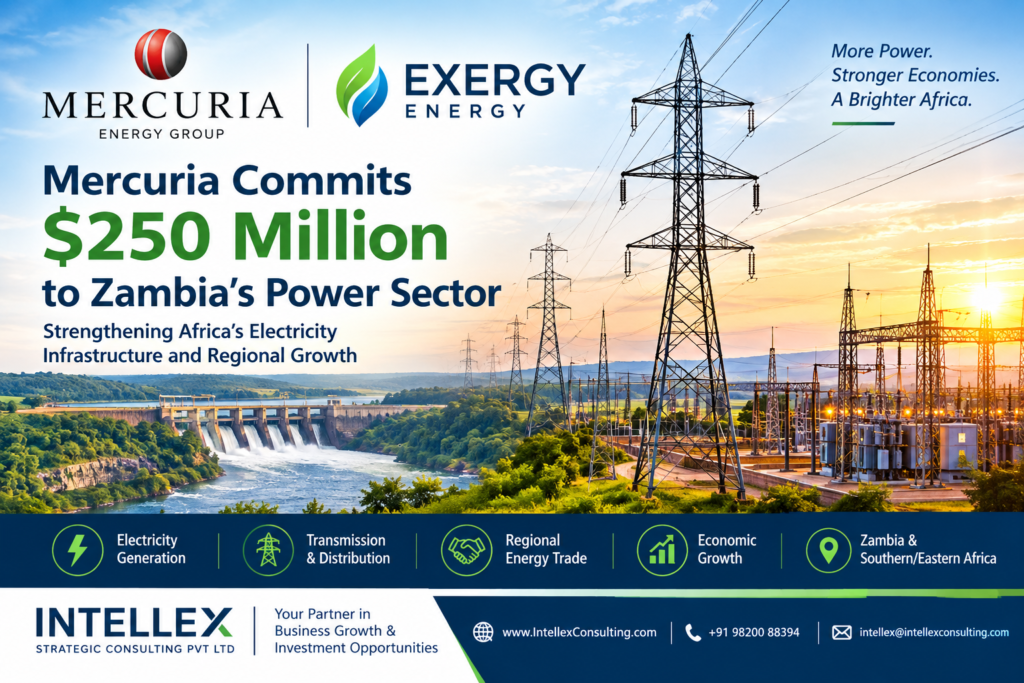
Mercuria Invests $250 Million in Zambia’s Power Sector: Exergy Deal to Expand African Electricity Infrastructure.
Mercuria signs a $250 million financing deal with Exergy Energy to support electricity generation and transmission projects in Zambia and across Southern and Eastern Africa.


Energy | Investment | Infrastructure | Zambia | Africa
Introduction: A Major Investment in Africa’s Energy Future
Global energy and commodities giant Mercuria Energy Group has signed a US$250 million financing agreement with Africa-focused energy investor Exergy Energy to support electricity generation and transmission projects across Southern and Eastern Africa, marking Mercuria’s entry into the region’s power market.
Announced in Lusaka, Zambia, on September 25, 2026, the agreement represents a significant private-sector commitment to strengthening Africa’s electricity infrastructure. The financing is expected to support projects being developed by Exergy’s subsidiaries, Lunzua Power Company and Lusitu Transmission and Distribution Company, subject to regulatory approvals.
The deal comes as Zambia seeks to expand its electricity supply, address persistent power shortages and strengthen its position as a regional electricity trading hub. It also reflects growing interest from international investors in Africa’s energy infrastructure, where electricity demand, industrial development and cross-border power trade are creating opportunities for long-term capital investment.
1. Understanding the $250 Million Mercuria–Exergy Investment
The financing agreement brings together two companies with complementary capabilities: Mercuria’s global energy trading expertise and Exergy’s regional electricity infrastructure development and operating platform.
The capital is intended to support electricity generation and transmission projects through Exergy’s subsidiaries. The companies have described the partnership as a combination of financial resources, energy market knowledge, risk management and project execution capabilities.
Key highlights of the agreement
| Particulars | Details |
|---|---|
| Total financing commitment | US$250 million |
| Investor and financing partner | Mercuria Energy Group |
| African energy platform | Exergy Energy |
| Announcement location | Lusaka, Zambia |
| Announcement date | September 25, 2026 |
| Project focus | Electricity generation and transmission |
| Geographic focus | Southern and Eastern Africa |
| Project companies | Lunzua Power and Lusitu Transmission & Distribution |
| Regulatory status | Subject to regulatory approvals |
The investment is designed to help accelerate infrastructure projects that can improve electricity availability and support the region’s growing industrial and commercial requirements.
2. Who Is Mercuria Energy Group?

Mercuria Energy Group is a global independent energy and commodities group headquartered in Geneva, Switzerland.
The company operates across multiple segments of the energy and commodities value chain, including crude oil, refined petroleum products, natural gas, liquefied natural gas, electricity, renewable energy, metals and carbon markets.
Its business combines commodity trading with investments in strategic assets and energy-related infrastructure. The company has also expanded its activities in areas associated with the energy transition, including low-carbon fuels, transition metals and technologies supporting decarbonisation.
Why is Mercuria entering Africa’s power market?
The company’s investment in Exergy reflects an opportunity to participate in the development of electricity infrastructure in a region where reliable power is essential for economic growth.
Mercuria brings several capabilities to the partnership:
Global energy trading expertise: Experience in international energy markets and electricity trading.
Market analytics: Knowledge of energy prices, supply-demand dynamics and cross-border energy markets.
Risk management: Expertise in managing the commercial risks associated with energy trading and infrastructure.
International relationships: Access to global energy market participants and commercial networks.
Strategic capital: Financing to support the development of power generation and transmission infrastructure.
Mercuria has stated that it sees private capital playing an important role in developing strategic energy infrastructure alongside development finance institutions and traditional development bank funding.
3. Exergy Energy: Building an Integrated African Power Platform

Its business model is built around developing and connecting electricity generation, transmission and trading activities. This integrated approach is intended to help address infrastructure bottlenecks and improve the commercial efficiency of electricity markets.
Exergy operates through three principal subsidiaries:
A. Lunzua Power Company
Lunzua Power focuses on electricity generation development and investment.
Its role includes developing power generation projects that can contribute to Zambia’s electricity supply and support growing demand from industrial and commercial customers.
B. Lusitu Transmission and Distribution Company
Lusitu focuses on electricity transmission and distribution infrastructure development.
Transmission infrastructure is essential for moving electricity from generating facilities to demand centres. Expanding and strengthening these networks can help improve the ability of power producers to supply customers and support cross-border electricity trade.
C. Kanona Power Company
Kanona operates in electricity trading and market optimisation.
Power trading can help balance electricity surpluses and deficits across markets, connecting available supply with customers that need electricity. This becomes particularly important when generation varies by season, geography or demand conditions.
Together, these businesses give Exergy exposure to multiple stages of the electricity value chain, from generation and network infrastructure to electricity trading.
Zambia is a major mining economy in Southern Africa, with substantial copper resources and ambitions to expand industrial production.
Electricity is essential to the country’s mining, manufacturing, agriculture, tourism and commercial sectors. However, the power system has faced challenges related to generation capacity, infrastructure constraints and dependence on hydropower.
The country’s electricity shortages became particularly visible during the severe drought in 2024, which reduced hydropower generation and disrupted electricity supplies.
These challenges have increased the importance of diversifying electricity sources, attracting private investment and strengthening transmission networks.
Zambia’s 10,000 MW electricity ambition
Zambia has set a target of reaching 10,000 megawatts (MW) of electricity supply by 2031.
Exergy’s project pipeline is expected to contribute to this broader ambition by supporting generation and transmission development.
The target is significant because electricity availability affects the country’s ability to expand industrial production, attract investment and support economic activity.
The Mercuria financing could help move selected projects forward, although the agreement itself does not establish that the full 10,000 MW target will be achieved.

The Mercuria–Exergy partnership is relevant to several of these challenges.
1. Expanding electricity generation
New generation capacity can help increase the amount of electricity available to households, businesses and industries.
For Zambia, additional power supply is particularly important for mining operations and other energy-intensive industries.
2. Strengthening transmission infrastructure
Electricity generation alone cannot resolve shortages if power cannot be transported to customers.
Transmission investments can help connect generating facilities with industrial centres and improve the movement of electricity across regions.
3. Supporting cross-border electricity trade
Electricity trading can help countries and power companies make better use of available generation.
A country with surplus electricity at a particular time may be able to supply a neighbouring market experiencing a shortage, subject to available infrastructure and market arrangements.
4. Improving energy security
Diversifying electricity sources and strengthening infrastructure can reduce the impact of disruptions affecting a single generation source or transmission corridor.
5. Supporting industrial growth
Reliable electricity is a critical input for mining, manufacturing, agriculture and other productive sectors.
Greater power availability can support business expansion, investment decisions and employment opportunities, although the scale of these benefits depends on the successful completion and operation of projects.
6. Zambia’s Strategic Position in Regional Electricity Trade
Zambia occupies a geographically important position in Southern Africa, bordering eight countries and participating in the Southern African Power Pool.
Its location provides opportunities to develop electricity trading relationships with neighbouring markets and strengthen connections with East and Central Africa.
The country’s ambition to become a regional electricity hub depends on several factors:
Adequate domestic generation capacity.
Reliable transmission and distribution infrastructure.
Cross-border interconnections.
Clear electricity market rules and regulatory frameworks.
Commercially sustainable power purchase and trading arrangements.
Exergy is also developing a transmission corridor intended to connect Zambia with the East African power market.
If successfully developed, such infrastructure could help improve regional connectivity and support electricity trade across a wider geographic area. The project’s actual impact will depend on construction, regulatory approvals and the availability of compatible cross-border infrastructure.

Mining is one of Zambia’s most important economic sectors, and electricity availability is a key factor influencing its production capacity and investment plans.
Copper mining and processing require substantial amounts of power. As Zambia seeks to expand copper production, the need for dependable electricity supplies is expected to remain a major infrastructure priority.
The Mercuria–Exergy investment could support the development of power infrastructure that benefits energy-intensive industries.
Potential benefits for businesses
Mining companies: Additional generation and transmission capacity could improve access to electricity and support expansion plans.
Manufacturers: More dependable electricity could help businesses reduce interruptions and improve production planning.
Agriculture: Electricity infrastructure can support irrigation, processing, storage and other activities across agricultural supply chains.
Tourism and hospitality: Improved power reliability can support hotels, commercial facilities and tourism infrastructure.
These are potential sector-wide benefits, not guaranteed outcomes of the financing agreement.
8. Investment Opportunities Emerging from Africa’s Energy Infrastructure Needs
The agreement highlights several areas where investors, infrastructure developers and financial institutions may find opportunities across African electricity markets.
A. Power generation projects
Investments in electricity generation can include conventional power plants, solar projects, hydroelectric facilities and other technologies suited to local market conditions.
The appropriate project mix depends on resource availability, electricity demand, regulatory frameworks and financing structures.
B. Transmission and distribution infrastructure
Transmission networks, substations, distribution systems and cross-border interconnectors are essential to delivering electricity to end users.
These projects can require substantial capital and long development periods, making financing structures and risk allocation particularly important.
C. Electricity trading and market services
As electricity markets become more interconnected, opportunities may emerge in power trading, market optimisation, balancing services and energy risk management.
Such activities depend on the rules governing electricity markets and cross-border transactions.
D. Energy storage and grid flexibility
Battery storage and other flexibility solutions can help electricity systems manage fluctuations in supply and demand.
Their commercial viability depends on project economics, market design and the availability of appropriate revenue streams.
E. Infrastructure investment and project finance
The sector may offer opportunities for infrastructure funds, private equity investors, private credit providers, development finance institutions and other capital providers.
Investors typically assess project bankability, regulatory approvals, power purchase agreements, construction risks, currency exposure and the financial strength of counterparties.
9. The Role of Private Capital in Africa’s Power Sector
Large electricity infrastructure projects often require significant upfront investment, while revenues may be generated over many years.
This creates a financing challenge, particularly in markets where electricity tariffs, currency volatility, payment risks and infrastructure constraints affect project economics.
Private capital can complement public investment and development finance by providing funding, commercial expertise and access to international energy markets.
The Mercuria–Exergy partnership illustrates one approach: combining an international energy group’s financial and trading capabilities with a regional platform that develops and operates energy infrastructure.
However, attracting private capital at scale requires more than financing commitments. Projects must also have clear regulatory approvals, credible revenue models, sound execution plans and effective risk management.
10. Key Risks and Challenges to Monitor
While the financing agreement represents a significant commitment, the successful delivery of the projects will depend on several factors.
| Risk area | Why it matters |
|---|---|
| Regulatory approvals | The announced financing is subject to regulatory approvals. |
| Construction and execution | Delays and cost overruns can affect project economics. |
| Financing and liquidity | Infrastructure projects require sufficient capital throughout development and construction. |
| Electricity market conditions | Demand, tariffs and trading arrangements influence revenue. |
| Currency risk | Foreign currency financing and local currency revenues can create exchange-rate exposure. |
| Counterparty risk | Payment reliability and the financial strength of electricity buyers are important. |
| Transmission constraints | New generation needs adequate network capacity to reach customers. |
| Environmental and social considerations | Projects must address relevant environmental, community and land-use requirements. |
Investors will need to assess these factors on a project-by-project basis rather than assuming that the overall financing commitment guarantees successful completion.
11. What Happens Next?
The immediate next steps involve securing the necessary regulatory approvals and advancing the projects supported by the financing agreement.
The partnership’s progress will depend on the development and execution of the generation and transmission pipeline through Exergy’s subsidiaries.
Key developments to watch include:
Regulatory approvals and the conditions attached to the financing.
Project-level funding allocations and financing arrangements.
Construction milestones for generation and transmission infrastructure.
Progress toward connecting new electricity supply to industrial and commercial customers.
Development of cross-border transmission links and electricity trading arrangements.
The contribution of Exergy’s projects to Zambia’s electricity supply ambitions.
The announcement establishes a US$250 million financing commitment, but detailed project-by-project allocations, construction timelines and commissioning dates will need to be confirmed through subsequent disclosures.
12. The Bigger Picture: A New Chapter for African Energy Infrastructure
The Mercuria–Exergy agreement reflects the growing role of international energy companies and private investors in developing Africa’s electricity infrastructure.
For Zambia, the financing comes at a time when electricity supply is closely connected to industrial expansion, mining growth and regional economic integration.
For the wider African market, the partnership highlights the potential of combining international capital, regional operating expertise and electricity trading capabilities to develop infrastructure across interconnected markets.
The success of the investment will ultimately depend on whether the projects are delivered on time, operate commercially and contribute to a more reliable electricity system.
If implemented successfully, the projects could help strengthen Zambia’s energy infrastructure and support the country’s role in regional electricity trade.
The US$250 million agreement is therefore not simply a financing announcement. It is a commitment to developing the infrastructure needed to support Africa’s growing electricity demand and economic ambitions.
About Intellex Strategic Consulting Pvt Ltd

Intellex Strategic Consulting Private Limited
Intellex Strategic Consulting Pvt Ltd provides strategic consulting, business finance, fundraising, investment facilitation and corporate advisory services to businesses and investors.
For companies exploring infrastructure investments, business expansion, capital raising, strategic partnerships or investment opportunities in India and international markets, Intellex can assist in evaluating potential opportunities and facilitating relevant business connections.
Contact: Sudheendra Kumar
Phone / WhatsApp: +91 98200 04701
Email: intellex@intellexconsulting.com
Websites: IntellexConsulting.com | IntellexCFO.com | VentureStreets.com | StartupStreets.com | CreditMoneyFinance.com | GrowMoreFranchisees.com
LinkedIn: Intellex Strategic Consulting
More Business Articles
Private Equity & Venture Capital: Financing the Next Growth Chapter of Startups and Businesses.
How Startups Can Raise Funding in Dubai: A Comprehensive Guide for Founders and Entrepreneurs.