
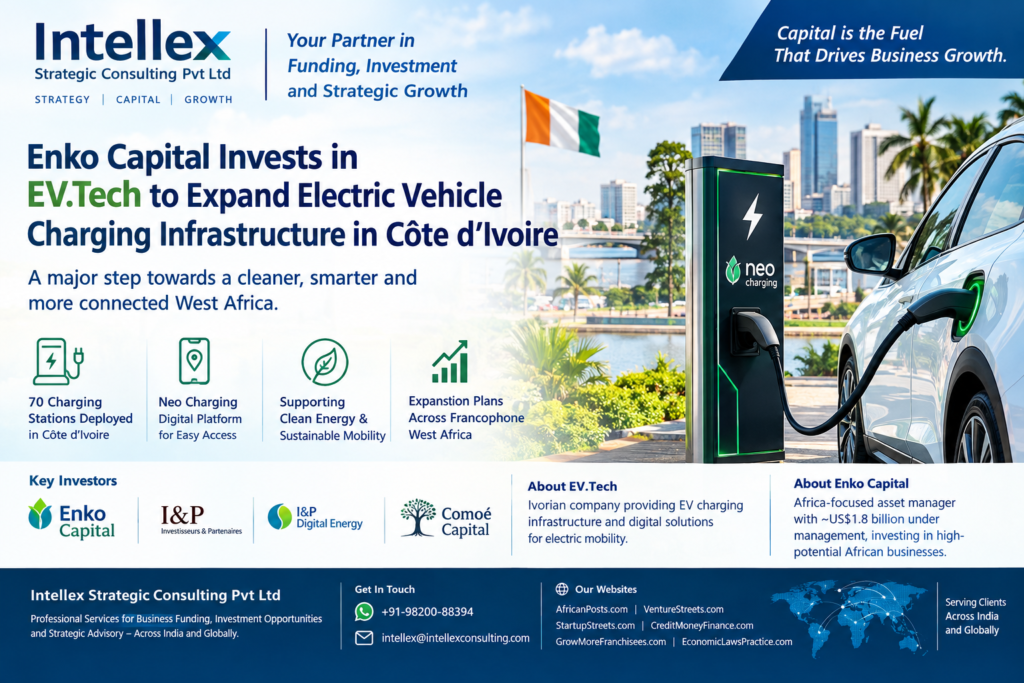
EV.Tech Côte d’Ivoire Raises Strategic Investment from Enko Capital to Expand EV Charging Infrastructure in West Africa.
Explore EV.Tech’s electric vehicle charging business in Côte d’Ivoire, its founders, investors, funding history, Neo Charging platform and Enko Capital’s latest hybrid financing.
EV.Tech’s New Investment Highlights the Growing Opportunity in African Electric Mobility
The development of electric mobility in Africa is increasingly moving beyond the question of electric vehicles themselves. A much larger infrastructure ecosystem is emerging around charging stations, energy management, digital charging platforms, fleet electrification, battery services, maintenance and financing.
A significant recent transaction illustrates this trend.
In August 2026, Enko Capital, through its Francophone West Africa SME strategy, announced an investment in EV.Tech, a Côte d’Ivoire-based company specialising in electric vehicle charging infrastructure. The investment has been structured as hybrid financing, with the objective of supporting EV.Tech’s expansion and preparing the company for future fundraising. The amount of the transaction has not been publicly disclosed.
EV.Tech currently reports a network of 70 charging stations across Côte d’Ivoire, alongside partnerships with major players in the transport and fuel-distribution sectors. Its business combines physical charging infrastructure with the Neo Charging digital platform.
For entrepreneurs, investors and companies examining African climate-tech opportunities, the transaction provides an interesting case study of how infrastructure-focused businesses can attract a combination of impact, growth and private-capital investors.
1. What Is EV.Tech?
EV.Tech is an Ivorian electric-mobility infrastructure company focused primarily on electric vehicle charging solutions.
Rather than positioning itself simply as an EV seller, the company addresses one of the fundamental infrastructure requirements for electric mobility: where and how vehicles can be charged.
Its offering includes:
- Installation of EV charging stations
- Maintenance of charging infrastructure
- Charging-network development
- Digital access to charging infrastructure
- Charging-station location services
- Real-time information regarding availability and pricing
- Monitoring of charging sessions
- Partnerships supporting electric-mobility adoption
- Development of solutions adapted to African operating conditions
The company’s Neo Charging application enables users to locate charging stations, view availability and pricing and monitor the status of their charging session.
This combination of hardware + infrastructure + software is important because the economics of electric mobility depend not only on vehicle sales, but also on the availability, reliability and accessibility of charging infrastructure.
2. The Founders Behind EV.Tech
EV.Tech was developed by entrepreneurs Florent Thomas and Esther Dagri, who have backgrounds in entrepreneurship and business development in Côte d’Ivoire.
Public sources contain slightly different references concerning the company’s founding date. Enko Capital describes EV.Tech as founded in 2021, while Investisseurs & Partenaires’ portfolio information describes the company as founded in 2023. Earlier reporting also traces the development of the project to 2021, when Florent Thomas imported what was described as the country’s first Tesla Model S and began exploring the absence of EV infrastructure.
The distinction is useful for readers because it appears that the business concept and early development originated in 2021, while some institutional portfolio records use 2023 as the formal company-foundation date.
Florent Thomas
Florent Thomas has been involved in entrepreneurship in Côte d’Ivoire since the 2000s. Earlier in his career, he founded a technology/security business and became involved in the country’s technology ecosystem.
His experience with electric vehicles led him to identify the absence of appropriate charging infrastructure as a market opportunity.
Esther Dagri
Esther Dagri is EV.Tech’s co-founder and has been associated with the company’s operational and administrative development. Enko Capital identifies her alongside Florent Thomas as a co-founder of the business.
Together, the founders have built EV.Tech around a relatively straightforward proposition:
Electric vehicles cannot scale without dependable charging infrastructure.
3. EV.Tech’s Business Model
EV.Tech operates in an infrastructure segment that can potentially generate several complementary revenue streams.
Charging infrastructure
The company installs and operates charging infrastructure for electric vehicles.
Installation and maintenance
Instead of simply selling charging hardware, EV.Tech provides installation and maintenance capabilities, allowing it to participate in the continuing operation of the infrastructure.
Digital platform
The Neo Charging application adds a software layer to the physical charging network.
Users can identify charging locations and obtain information about availability, pricing and charging status.
B2B and fleet opportunities
Commercial fleets are potentially important customers for charging infrastructure because fleet operators can plan vehicle utilisation and charging requirements more systematically than individual consumers.
Partnerships
EV.Tech has developed relationships with businesses operating in transport and fuel distribution, creating potential distribution and infrastructure-development channels.
4. EV.Tech’s Charging Network
One of the most important figures disclosed in the latest investment announcement is the company’s 70 charging stations deployed across Côte d’Ivoire.
This represents a meaningful shift from the company’s early-stage position.
Earlier reporting in 2023 described EV.Tech as developing the first charging network in Côte d’Ivoire and pursuing a substantially larger deployment programme. At that time, the company was seeking approximately CFAF 4.2 billion, equivalent to roughly €6.4 million at the exchange rate used in contemporary reporting, for infrastructure expansion.
The 2026 figure of 70 deployed stations demonstrates that the business has progressed from an infrastructure-development concept toward an operating network.
5. Neo Charging — The Digital Layer
One of EV.Tech’s potentially important differentiators is that it is not solely an infrastructure company.
Its Neo Charging platform provides a digital interface for the charging network.
According to I&P’s portfolio information, the platform enables drivers to:
- Locate charging stations
- Check station availability
- View tariffs
- Monitor charging status
- Interact with the NEO multi-operator network
This software layer could become increasingly important as charging networks expand.
A mature charging ecosystem generally requires more than physical stations. It needs:
Station → Connectivity → Customer identification → Payment → Monitoring → Data → Fleet management
This creates opportunities for infrastructure companies to develop recurring digital and service revenues alongside physical infrastructure.
6. EV.Tech’s Earlier Funding and Investors
One of the most useful aspects of EV.Tech’s development is the progression of its investor base.
Publicly available information identifies Investisseurs & Partenaires (I&P), I&P Digital Energy and Comoé Capital in connection with the company’s earlier institutional support.
I&P’s portfolio records show EV.Tech as being in its portfolio since March 2025 and classify the company as a seed-stage investment.
I&P / Investisseurs & Partenaires
Investisseurs & Partenaires (I&P) is an African impact-investment group focused on financing and supporting entrepreneurs and SMEs.
I&P reports more than two decades of activity, 350 SMEs financed and €480 million raised across its activities.
I&P Digital Energy
EV.Tech has been supported through I&P Digital Energy, a €4.8 million programme designed to finance and support around a dozen African startups and SMEs developing digital solutions for affordable energy access.
The programme is backed by the French Development Agency (AFD) and the European Union, with implementation in Côte d’Ivoire handled by Comoé Capital.
The support for EV.Tech was intended, among other things, to help finance charging terminals, strengthen the commercial team and validate its mobile-charging solution.
Comoé Capital
Comoé Capital is an Ivorian investment fund supporting high-potential SMEs and startups.
Comoé Capital provides minority equity and seed financing as well as strategic support and technical assistance. Its published financing range for Ivorian entrepreneurs is approximately CFAF 20 million to CFAF 300 million, although individual investment terms vary.
Its published information identifies I&P among its founding private-sector participants and lists other institutional and corporate shareholders and partners including Orange, Eurofind, CDC Côte d’Ivoire, NSIA, SGBCI, AFD and others.
7. Enko Capital Becomes the Latest Major Investor
The latest development is the investment by Enko Capital through its Francophone West Africa SME strategy.
Enko Capital is an Africa-focused asset-management firm established in 2008.
Its current website states that the group manages approximately US$1.8 billion across its strategies and invests across debt, private debt, equity and private equity.
The company’s investment activities cover African markets through several strategies, including private equity and private debt.
Its private-equity strategy focuses on African mid-market growth companies and typically takes minority positions, while the firm also has dedicated Francophone African investment activities.
8. What Is Enko Capital’s West Africa SME Strategy?
The transaction with EV.Tech was made through Enko’s Francophone West Africa SME Strategy, structured as a Fonds Commun de Placement à Risques (FCPR).
The strategy is designed to invest in high-potential SMEs operating across Francophone West Africa.
According to Enko, the strategy focuses on companies with strong entrepreneurial teams and provides financing solutions that can be adapted to companies’ different stages of development.
The EV.Tech transaction is particularly interesting because it was structured as hybrid financing, rather than being described simply as a conventional equity investment.
The amount was not disclosed.
9. The Fund’s Growing Institutional Investor Base
Another significant development occurred shortly before the EV.Tech announcement.
In September 2026, Caisse des Dépôts et Consignations of Benin (CDC Benin) became an investor in Enko Capital’s Francophone West Africa SME Strategy.
This is important because institutional capital can provide private-equity funds with the ability to support a larger number of regional businesses.
The FCPR strategy was licensed by the AMF-UMOA in December 2025, according to reporting on the fund. Public reporting has indicated a targeted fund size of approximately CFAF 20 billion, although the amount raised to date and CDC Benin’s individual commitment were not disclosed.
The investment in EV.Tech was described by Enko as the second transaction completed under the FCPR strategy, following its investment in Burger King Côte d’Ivoire.
10. Why Enko’s Investment Is Significant for EV.Tech
The investment provides EV.Tech with more than additional capital.
According to Enko, the hybrid financing is intended to:
- Support infrastructure expansion
- Provide resources for the next stage of development
- Help prepare the company for future fundraising
- Allow EV.Tech to capture opportunities arising from electric-mobility growth in Côte d’Ivoire and the wider sub-region
This last point is particularly relevant.
For infrastructure businesses, funding requirements can change dramatically as a company moves from pilot projects to national deployment.
An initial investor may finance:
Product development → Pilot → Early customers → Infrastructure rollout
A subsequent investor can provide:
Growth capital → Network expansion → Working capital → Regional expansion → Larger institutional fundraising
EV.Tech is now entering this latter phase.
11. What Makes Côte d’Ivoire Interesting for Electric Mobility?
Côte d’Ivoire has several characteristics that could support the development of electric mobility.
These include:
- Rapid urbanisation
- Concentrated economic activity around major urban centres
- Growing interest in sustainable transportation
- Increasing availability of EV models
- Commercial and corporate fleet opportunities
- Development of charging infrastructure
- Government interest in energy transition
- Potential regional expansion opportunities
Enko specifically cited rapid urbanisation, rising fossil-fuel costs, technological progress and increasing public-sector commitment to the energy transition as factors supporting its outlook for electric mobility in West Africa.
12. EV.Tech’s Regional Expansion Potential
EV.Tech’s opportunity potentially extends beyond Côte d’Ivoire.
Earlier management commentary identified potential expansion projects involving Senegal, Togo and Benin.
This is strategically relevant because Francophone West Africa shares several characteristics:
- WAEMU economic integration
- Common or closely connected business environments
- French-language commercial ecosystems
- Regional transport corridors
- Growing urban populations
- Similar infrastructure-development requirements
A successful charging model in Côte d’Ivoire could therefore provide a platform for expansion into neighbouring markets.
However, expansion would still require country-specific assessment of electricity infrastructure, regulation, vehicle adoption, charging economics, customer demand and capital requirements.
13. Partnerships Can Be as Important as Funding
EV.Tech’s development also demonstrates why strategic partnerships matter in infrastructure businesses.
The company has worked with businesses in the automotive and transport ecosystem.
For example, EV.Tech has collaborated with AUTO24 in connection with electric vehicles and charging infrastructure. Contemporary reporting also described collaboration involving Julaya and other mobility players.
Such partnerships can help infrastructure startups solve one of the biggest challenges in emerging markets:
building demand and infrastructure simultaneously.
Vehicle sellers need charging infrastructure.
Charging companies need vehicles.
Fleet operators need reliable charging.
Energy companies need new sources of demand.
Technology companies can provide payment and digital infrastructure.
This creates the possibility of an interconnected electric-mobility ecosystem.
14. From Charging Stations to an EV Ecosystem
EV.Tech’s business model illustrates how the electric-mobility opportunity can be much larger than charging stations alone.
Potential adjacent opportunities include:
Charging-as-a-Service
Businesses and fleets can outsource charging infrastructure rather than making all infrastructure investments themselves.
Fleet Electrification
Corporate fleets, logistics companies, taxis and other commercial operators can become significant users of charging infrastructure.
Battery Services
Battery diagnostics, battery swapping and related services may become important as electric two-wheelers and three-wheelers expand.
Earlier EV.Tech development work included exploration of battery-swapping solutions for electric motorcycles.
Digital Payments
Charging transactions can be integrated into mobile payment and digital financial ecosystems.
Data Services
Charging networks generate data about locations, usage patterns, charging frequency and fleet behaviour.
Energy Management
As charging networks expand, smart energy management can become increasingly important.
15. A Funding Timeline for EV.Tech
| Period | Development |
|---|---|
| 2021 | EV.Tech project development associated with Florent Thomas and the emergence of EV infrastructure initiatives in Côte d’Ivoire |
| 2023 | Public reporting highlighted EV.Tech’s planned CFAF 4.2 billion / approximately €6.4 million Series A fundraising effort |
| 2023–24 | Development of charging infrastructure, Neo platform and partnerships within the electric-mobility ecosystem |
| March 2025 | EV.Tech recorded in I&P’s portfolio through I&P Digital Energy / Comoé Capital |
| 2025–26 | Expansion of charging infrastructure and development of the NEO network |
| August 2026 | Enko Capital announces hybrid financing through its Francophone West Africa SME strategy |
| September 2026 | CDC Benin becomes an institutional investor in Enko’s West Africa SME Strategy |
| 2026 | EV.Tech reported with approximately 70 charging stations across Côte d’Ivoire |
The funding amounts of the I&P/Comoé Capital investment and Enko Capital transaction have not been publicly disclosed in the sources reviewed.
16. What Investors and Entrepreneurs Can Learn From the EV.Tech Story
EV.Tech provides several useful lessons for African entrepreneurs.
1. Infrastructure gaps can create large business opportunities
The absence of charging infrastructure initially represented a market constraint. EV.Tech approached the problem as an opportunity to build the missing infrastructure.
2. Hardware businesses benefit from a software layer
Neo Charging provides EV.Tech with a digital interface in addition to its physical infrastructure.
3. Strategic investors can provide more than capital
The involvement of impact investors, local investment platforms and a regional private-equity firm creates access to different forms of capital and expertise.
4. Hybrid financing can be useful for growth companies
Not every company needs to rely exclusively on ordinary equity. Different combinations of equity, quasi-equity and debt-like instruments can potentially be structured around cash flows and growth requirements.
5. Institutional investors can strengthen regional capital markets
The participation of institutions such as CDC Benin demonstrates the potential role of domestic institutional capital in financing West African SMEs.
17. Important Information for Prospective Investors
Investors considering EV.Tech or comparable African EV infrastructure companies should examine several areas before making investment decisions.
These include:
Infrastructure economics
- Cost per charging station
- Utilisation rates
- Electricity costs
- Maintenance expenses
- Network uptime
Customer economics
- Number of active EV users
- Fleet customers
- Average charging frequency
- Average revenue per charging session
- Customer acquisition cost
Capital requirements
- Cost of infrastructure expansion
- Working-capital requirements
- Replacement cycles
- Technology investment
Regulatory environment
- Electricity regulation
- Charging-station licensing
- EV import policy
- Tax incentives
- Environmental regulations
Technology
- Charging standards
- Software interoperability
- Payment systems
- Data management
- Cybersecurity
Expansion
- Country-by-country regulatory requirements
- Electricity-grid reliability
- EV penetration
- Commercial fleet demand
- Local partnerships
For readers evaluating the opportunity from an investment perspective, the disclosed transaction is not a guarantee of commercial performance. The amount invested by Enko and the detailed commercial terms have not been publicly disclosed.
18. What the Enko–EV.Tech Transaction Says About African Private Capital
Perhaps the broader significance of the transaction lies beyond EV.Tech itself.
African private capital is increasingly moving toward businesses addressing fundamental infrastructure and economic-development requirements.
Electric mobility is one example.
Other areas include:
- Renewable energy
- Distributed energy
- Manufacturing
- Logistics
- Digital financial services
- Healthcare
- Food processing
- Industrial technology
- Climate technology
- Infrastructure services
Enko’s investment approach demonstrates how an African-focused investment manager can combine regional knowledge with structured capital to support companies moving from early-stage development toward expansion.
Enko’s broader platform currently spans public debt, private equity and private debt strategies, while its West African operations provide a regional presence in Francophone markets.
19. Opportunities for Indian and International Businesses
The EV.Tech case is also relevant to companies outside Africa.
Indian companies, technology companies, infrastructure developers, manufacturers, investors and financial institutions increasingly have opportunities to participate in African growth sectors.
Potential areas include:
- EV charging equipment
- Charging-management software
- Renewable-energy integration
- Solar-powered charging
- Battery technology
- Fleet management
- Electric two-wheelers and three-wheelers
- EV financing
- Infrastructure financing
- Project finance
- Strategic partnerships
- Joint ventures
- Technology licensing
- Manufacturing partnerships
For businesses seeking to enter African markets, understanding the local investor ecosystem, regulatory environment, capital requirements and potential strategic partners can be as important as having the underlying technology.
20. Intellex Strategic Consulting Pvt. Ltd. — Funding and Strategic Advisory for Growth Businesses
The development of EV.Tech also illustrates the type of complex growth situation where companies require a combination of capital strategy, investor identification, financial structuring and strategic advisory.
Intellex Strategic Consulting Pvt. Ltd. provides professional services related to business funding, investment opportunities and strategic financial requirements for businesses across India and international markets.
Our areas of assistance can include:
- Startup fundraising
- Growth-stage fundraising
- Venture capital introductions
- Private equity opportunities
- Debt funding
- Project finance
- Working-capital funding
- Business expansion finance
- Strategic investors
- Investment partnerships
- M&A advisory
- Financial modelling
- Investor presentation and fundraising strategy
- Pre-IPO and IPO consulting
- Cross-border funding opportunities
For companies in sectors such as EV technology, advanced manufacturing, renewable energy, infrastructure, logistics, technology, healthcare, industrial products and other growth industries, the ability to identify appropriate sources of capital and structure an investment proposition can be an important part of the growth journey.
Capital is the Fuel That Drives Business Growth.
Intellex Strategic Consulting Pvt. Ltd.
WhatsApp: 91-98200-88394
Email: intellex@intellexconsulting.com
Our websites:
AfricanPosts.com
VentureStreets.com
StartupStreets.com
CreditMoneyFinance.com
GrowMoreFranchisees.com
EconomicLawsPractice.com
Conclusion
The Enko Capital investment in EV.Tech is an important example of the evolving financing landscape for electric mobility and climate-related infrastructure in Francophone West Africa.
EV.Tech has progressed from an early-stage initiative addressing Côte d’Ivoire’s lack of EV charging infrastructure to a business with a reported 70-station network, a proprietary digital charging platform and strategic relationships across the mobility ecosystem.
Its funding journey also demonstrates the potential value of combining impact investment, local SME capital, strategic partnerships and growth-oriented private equity.
With Enko Capital now providing hybrid financing through its Francophone West Africa SME strategy, the next phase will be focused on expansion, infrastructure deployment and preparation for future fundraising. The company’s development will be worth watching as Côte d’Ivoire and neighbouring West African markets build out the infrastructure required for broader electric-mobility adoption.
For entrepreneurs and investors, the larger lesson is clear: the African EV opportunity is not limited to manufacturing vehicles. Charging infrastructure, digital platforms, energy management, fleet solutions and financing could become equally important components of the emerging electric-mobility ecosystem.
Information in this article is based on publicly available sources reviewed through 27 September 2026. Investment amounts and certain commercial terms have not been disclosed publicly. The article is intended for informational purposes and does not constitute investment advice.
More Featured Articles
Launch Your Own Skincare, Haircare & Personal Care Brand Through White-Label Manufacturing.
Private Equity & Venture Capital: Financing the Next Growth Chapter of Startups and Businesses.
11 Priceless Personal Growth Lessons That Can Transform Your Financial Success and Life.
How Startups Can Raise Funding in Dubai: A Comprehensive Guide for Founders and Entrepreneurs.
The Ultimate Guide to Company Registration in Dubai 2026: Benefits, Compliance, and Costs.
Why Kjøller (Dubai) is an important Venture Capital Investor for Startups Globally.
Singapore’s 15% Minimum Tax Is Changing How Multinationals Structure Their Operations in Asia.
The Ultimate Guide to Company Registration in Dubai 2026: Benefits, Compliance, and Costs.